
| Engineering home | About Engineering | Departments and schools | Courses | Research | Contact Engineering |
| Staff directory | A-Z index | Site map |
| Engineering home | About Engineering | Departments and schools | Courses | Research | Contact Engineering |
| Staff directory | A-Z index | Site map |
|
In many cases the aircraft will perform the same duties as Lawrence Hargrave's Box Kites did some 100 years ago, the gathering of meteorological data. Being pilotless however and in the case of the Aerosonde, relatively inexpensive and thus expendable, they are ideally suited to be deployed into hazardous situations such as hurricanes, cyclones and social conflict etc.
"Eye in the Sky" is the working title for a project devised by Professor John Bird in partnership with CTIE Aerobotics at Monash University
 Robofly
 At last one of the longest running scientific mysteries has been solved. Researchers in San Francisco, USA have finally discovered how insects fly.
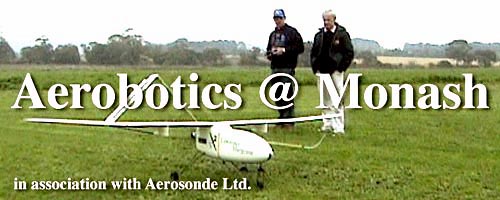
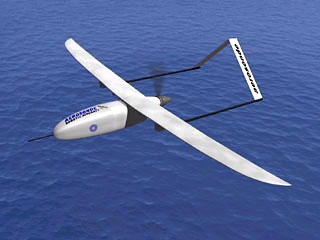
The Aerosonde is a small robotic aircraft for long-range environmental monitoring and surveillance.
In July 1998 NASA offered a $299 million grant for the organisation that develops the most compelling space exploration mission. Further Reading |
Return to Aerobotics
The term Aerobotics is © Copyright 1999-2007, CTIE
© Copyright 1999-2007 CTIE - All Rights Reserved
- Caution
Created and maintained by russell.naughton@eng.monash.edu.au
Last updated March 28, 2007March 28, 2007